Malbec from Cahors, Mendoza and Patagonia

Updated: Jan 19
Malbec is a grape varietal native of France. In the past it was a major component of Bordeaux wines but it gave way to more Cabernet Sauvignon and Merlot due to its susceptibility to frost and fungal infections. Cahors, East of Bordeaux, remained loyal to Malbec and became its home. See below the location of Cahors in Southwestern France:

Cahors is a beautiful medieval town worth visiting. It is located in a rural and quaint region and has roman and medieval monuments including the fortified bridge over the Lot river that flows around the old town.

Its vineyards are orderly planted in flat lands at an average elevation of 300 meters in predominantly limestone soils with abundant stones.


Malbec was brought to Argentina in the mid 1900s by French agronomist Michel Pouget. The Argentine grape bunches are smaller and tighter than the ones from France, and the grapes are smaller, suggesting that the clone brought by Pouget is distinct and extinct in France, giving the Argentinians a good argument when they call Malbec their national varietal.
In addition, Malbec is cultivated in Mendoza, the main Argentine wine region, at elevations between 900 and 1,700 meters, at the base of the impressive Andes mountains. See a Mendoza vineyard below:

That elevation, one of the highest in Worldwide viticulture, provides a sharp fluctuation in diurnal temperatures, allowing the grapes to maintain their acidity as well as slowing down glucose production at night while the aromatic compounds develop.
Average yearly temperatures are very similar for Mendoza and Cahors, while Neuquen in Patagonia, contrary to the prevalent perception, has higher temperatures. See graph below (keeping in mind that the seasons are inverted in the Southern Hemisphere).

As you travel South from Mendoza to Patagonia you should be seeing lower temperatures since you get further away from the equator. However, most Patagonia vineyards are located at elevations between 300 and 500 meters, in the Neuquen rand Negro rivers basins. This elevation is much lower than Mendoza's, and that explains the warmer micro-climate.
Precipitation is close in Cahors and Mendoza while Neuquen in Patagonia is significantly drier and has permanent sun exposure. Fortunately, they have the Neuquen river transporting Andes' snow melt for irrigation. Neuquen's severely dry conditions and the pervasive winds keep the vines healthy and easily enable organic agriculture.

The following chart shows the relative position of these three wine regions to sun exposure and Growing Degree Days. GDD is a measure of temperature developed at UC Davis by Professor Winkler in 1944 that considers the number of hours above 10 °C during the growing season.

Therefore, we can establish the following comparisons:
Mendoza and Cahors have similar temperatures and precipitation but diverge in elevation and the Malbec grape clone.
Neuquen (Patagonia) is at a lower elevation than Mendoza and is sunnier, warmer and significantly drier than the other two regions.
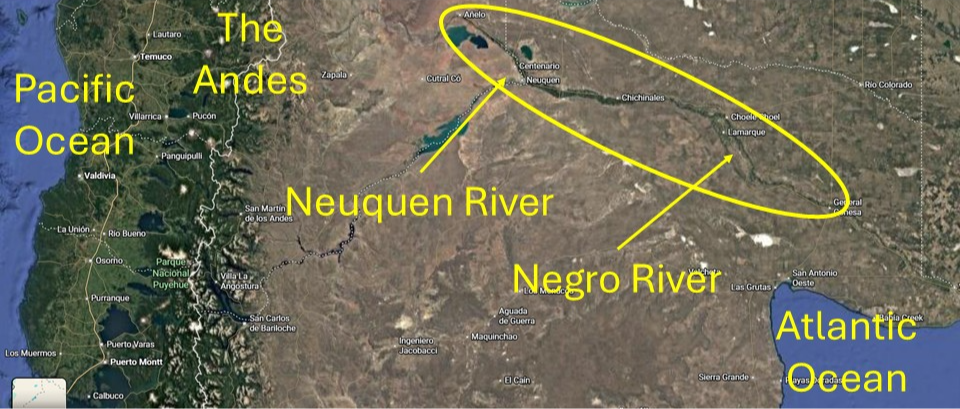
Cahors has predominantly limestone soils while Valle de Uco in Mendoza has alluvial soils composed of loam, sand, stones and gravel, and Neuquen in Patagonia has rmostly iver bed gravel. All these soils are very suitable for quality viticulture with the soils in Argentina poor in nutrients and with good drainage stimulating the growth of deep root systems. In addition, the lack of rain in Neuquen makes irrigation a necessity and prevents fungal disease making it ideal for organic agriculture. See map of the Patagonia wine region as a river-base oasis surrounded by desertic Patagonia landscape:
These differences in terroir must have an influence in the wine, so that Sally and I undertook the mission to identify it.

See below the results of our tasting:
Château Vincens 2022, Malbec, Cahors

This wine has a predominant aroma of crashed blackberries and pomegranate – not complex but intense and very pleasant. The bouquet speaks of aging in probably medium roast used French oak barrels with some very subtle hints of chocolate powder. Its yummy acidity and thick tannins in a dense structure hold promise for significant improvement if cellared for several years.
92 pts. WE
$12.99 14.5% Alcohol
Zuccardi Serie A, Malbec, Valle de Uco,Mendoza

Ripe red plums, dry cherries and pomegranate with a very subtle hint of violets. Medium to full body, drying tannins and bright acidity. Bloody. Fruit forward wine with no obvious effect of oak aging (most likely crafted in concrete deposits) and short duration aftertaste.
91 pts. JS
$10.99 13.9% Alcohol
Hector Durigutti 2024, Malbec, Patagonia

As a result of its terroir, the old vines and the wine style selected by the winemaker this wine has light color for a Malbec with bright raspberry hues. The aroma is delicate and elegant, not as blush as in Mendoza, showcasing red cherries, low roast coffee and earth. In mouth the cherries became maraschino and their aroma evaporated invading the upper palate. Velvety and slightly chalky tannins, perfect acidity and medium body (lighter than most Malbecs) with signs of a moderate oak aging touch. Clean, medium depth aftertaste. Well crafted.
$12.99 13.9% Alcohol
And, this is the one that Sally chose:

Me too. Its delicate aromas and structure and its finesse and elegance captivated us. And we liked the fact that it came for such a place as Patagonia, near the end of the World!


