Wines from Arganda, D.O. Madrid - Yes, you've read it correctly!

Updated: Jan 21
Dear friends,
During my October 2024 - June 2025 stay in San Lorenzo de El Escorial, Madrid province, I had the opportunity to travel through Spain and visit interesting wine regions and wineries. To my delight, some of those trips were short because Madrid province has developed a diverse wine industry with a large assortment of wines. From small, traditional wineries, to small boutique ones, to incipient larger producers, using local and French grape varietals, the wines from Madrid are constantly improving and have reached a level that deserves nationwide and even international attention.
San Lorenzo de El Escorial, Monastery, and Sierra de Guadarrama
The Vinos de Madrid denomination of origin (D.O.) is predominantly administrative. With almost 22,000 acres of vineyard and 3,000 vine growers it produces about 1% of the wine in Spain. The main D.O. requirement above terroir, grape varietals, or other technical considerations, is that wines must be from Madrid province and, even in many cases, it uses the provincial border as its own. However, within the denomination, there are 4 zones, San Martín de Valdeiglesias, Navalcarnero, Arganda and El Molar that are based on terroir.

San Martín de Valdeiglesias lies south of the intersection between the Sierra de Gredos and Sierra de Guadarrama mountains. It has an abundance of granite soils. Its Garnacha (Grenache) is typically light color, mineral and expresses delicate aromas. Its white varietal, Albillo Real, is something to be discovered, or better, re-discovered. It is a very interesting zone whose wines have been reaching international acclaim and can command prices above the rest of the D.O. For more information see my December 19th, 2025 post "Learning about Terroir at Bernaveleva with Juan Díez Bulnes".
Navalcarnero represents 15% of the production and has only 2 wineries under the D.O., and El Molar has been recently added and only has 1 winery under the D.O. Therefore, I decided to focus of Arganda .
Arganda is the largest zone with 60% of the wine production and 28 wineries. It lies southwest of Madrid and includes important historic towns with centuries-old wine culture such as Arganda, Aranjuez, Titulcia, Morata de Tajuña, Chinchón and Colmenar de Oreja. I had to be selective for my field trip and chose to start in Titulcia and drive along the Tajuña river to the highlands of Chinchón followed by Colmenar de Oreja.

Titulcia lacks significant monuments but offers an interesting setting on a promontory surrounded by the Jarama and Tajuña rivers. The river valleys are fertile and of relatively low elevation because they run along a fault. In ancient times it presented a perfect location for the Celtiberians, followed by the Romans.
My cousin Josechu had a weekend house at the top of the town. I still wake up with nightmares about the day he took my brother Juancho and me to visit some ancient caves in the middle of the fault's wall. It was the narrowest possible path, only suitable for children, with schist soil that crumbled as we walked and fell more than 100 feet to the valley.
Titulcia has the winery (bodega) Viña Bayona where a variety of wines based on the local vineyards are produced. I particularly like their Blanco Sobremadre (fermented with its grape skins and aged on them for 3 months). It is made with 100% old vine Malvar which is Madrid's white varietal. No racking or pump overs were employed so that the wine had a slight natural fizz that I found playful and refreshing.

Their Tempranillo rosé was also attractive. It is fermented in tinajas (clay amphorae).

Those are traditional "old-fashion" winemaking methods that, after the recent international success of Georgian wines, is taking on a revival. Tinajas are made with semiporous clay that allows Oxygen micro-permeation while they remain impermeable to liquids. This results in a very slow aging of the wines through mild oxidation.

I had learned about this winery from José Luis Rodríguez Oriza. He is a one-man-show that produces his own wines using the Viña Bayona's facilities.
Viña Bayona Winery, José Luis Rodríguez's (behind me) and his wines
José Luis decided to produce his own wines with a friend in an old tavern in Madrid's Conde Duque neighborhood. For many years this tavern has only been offering wines from Madrid and twisting its customers' arm to try them, to the point that they have created a loyal following. José Luis vinifies the red varietals separately and assembles them seeking each year the optimum proportions. His red is based on Tempranillo with some addition of Cabernet Sauvignon and Merlot. I tried the crianza and it was quite satisfying for a very affordable price. His "blanco sobremadre" is vinified with Malvar grapes fermented and aged with their skins. I detected grapefruit peel, fennel, thyme and bread, but also some hints of Niagara grape foxiness. In mouth it became more citric. Silky texture and light to medium body.
I asked at Viña Bayona for a good place for lunch and they recommended right away Casa Miro. I had a hearty meal for about $12 if I remember correctly. Profusely decorated with agricultural objects, it is a place where the locals and contractors doing work in that area would have lunch. It hosts Madrid customers during the weekends.
Pork short ribs with potatoes and house wine with soda at Casa Miro
Cheap tannic, acidic, alcoholic wine is typical of some menu del día (daily menu) restaurants. If you combine it with gaseosa (Spanish soda) it becomes lighter, sweeter and more drinkable. The proportions will be your own determination. And, if you dare, you can ask for more, included in the price.
And with a full stomach but little wine, since I had to drive, and a café express I departed for my road trip along the Tajuña river valley. In the river banks near Titulcia I walked through vineyards grown in espalderas (vertical trellises) on silt soil but as I proceeded east, I bumped into amazing vineyards with very old vines grown in goblet which is the traditional method in this area. Notice the spacing between vines. That's necessary for vine survival in a very dry climate if you don't have irrigation. Extremely low yield per acre that results in aromatic concentration.
I loved these ancient goblets and did not want to leave them alone!

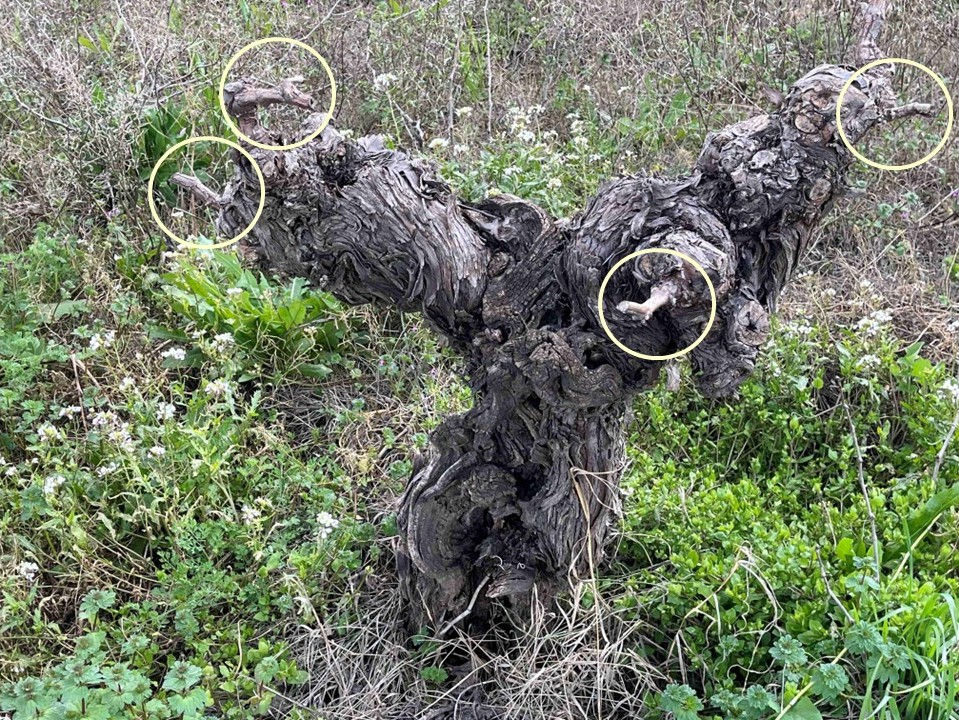
Notice how these vines are pruned. In the one below only 4 short shoots were left. This practice reduces the yield to ensure that the few grape bunches that the vine will produce will have intense aromas
Further northeast along the Tajuña valley, lays the Val Azul winery and their surroundings that they proudly call "La Toscana Madrileña". What a wonderful marketing / branding!


The vines are grown in trellises and have irrigation resulting in a vineyard. This winery specializes in French varietals from its own vineyards and ages its wines in French oak barrels. Eva Rodríguez, the owner and enologist, continues the family tradition. I tasted their Cabernet, Merlot, Shiraz aged in used French and American oak barrels. Ripe fruits and chocolate. The tannins were thick but friendly, hugging my tongue and palate from inside my mouth. Medium to long bouquet. In a blind tasting, asked about Bordeaux, California or Chile, I would have guessed the latter.

I had learned about them from Blanca Pérez de Camino, Val Azul's operations manager and Lucas Sanz at the "Vivan los Vinos de Madrid" event that was organized by the city of San Lorenzo de El Escorial on February 7th-9th, 2025.

This was a very interesting event where several wineries presented their wines and several local restaurants provided the food pairing based on tapas with an inspiration in the typical Cocido Madrileño.
And the moment came to leave the valley and head towards Chinchón. While on the road I was able to see several soil types such as clay, limestone, their combination, and schist. This variety of soils is proper from the Arganda zone and offers many possibilities regarding the type of vine and wine to be produced. While the old cooperatives might mix wine from many different soils, many if not most of present day Madrid D.O. vintners are careful about segregating the vineyards and expressing their terroir.
And finally I arrived at Chinchón. This old monumental town offers a castle, convents, parador, noble mansions, winding cobble stone streets and, above all, the main square that is converted seasonally into a bullfighting ring.
Almost every building in this large ancient square is a restaurant. If you like baker's oven roasted suckling pig or lamb, or cocido madrileño, or roasted vegetable dishes you will enjoy them much. Unlike Titulcia, you will find tourists (foreign and from Madrid) around you. I am showing below some of my typical Central Spain dishes plus one from Begoña and one from Joyce to illustrate what you can expect.
And I headed towards Colmenar de Oreja. The vineyards were all over the place. The predominant soil was a combination of clay and limestone. Many of the vines were very old, and many planted as goblets, although I also saw trellises with irrigation.

One of the best wineries in town is La Peral, where Begoña's husband Alessandro takes visitors for wine tourism tours.

This winery produces an assortment of wines from "sobremadre" white and red to more standard crianza and "author" wines. They also offer herb liqueur and quite a nice vermouth.
Jesús Díaz e Hijos, also in Colmenar de Oreja, is a winery that remains part of my childhood memories. A colleague of my father was a close relative of the winemaker and one September invited our family to participate in the harvest. We worked hard collecting grapes side by side with them. At lunch time we sat under the shade of a big tree and ate a hearty rabbit stew that the mother had prepared. We went back to town on the tractors escorting the harvest. We then visited the winery and walked in the upper level by the mouth of the tinajas. I remember I leaned forward to smell the aroma and the owner pulled me away with a fast movement of his arm warning me that I could have fainted due to the emissions from the fermentation and fallen into the tinaja. The picture below is not mine but it took me about 55 years back. And it looks identical to what I remembered.

Their white wine, called Colmenar was during many years the house wine at Pastelerías Mallorca, a high end Madrid pastry shop chain. Sally used to love both this wine and the pastry shop when we lived in Madrid.

I reached the Suthern end of Colmenar de Oreja and saw the end of the high land where their vineyards were planted with solling slopes planted with olive trees towards the lower plateau of La Mancha, another wine region.

And going back to the San Lorenzo de El Escorial event, I had the opportunity to taste other wines, such as Licinia. I had tried this wine from Morata de Tajuña before; actually in the US, and I was impressed. And this time my impression did not change. What a blend of Cabernet, Syrah and Tempranillo aged in French oak! Intense black and white pepper initially prevailed over other aromas. With time they gave way to ripe blackberry, prune, red raisins and chocolate. Loli, the winery rep, added plum, coffee and tobacco which I detected after she told me. The acidity compensated the still fresh tannins. Dense structure with volume, 15.5% ABV and powerful like saying "here I am!" I would have it with an ox tail stew. I also loved the label.


Loli also offered me their white wine. A blend of Malvar, Torrontés and Moscatel de Grano Menudo (Muscat a Petit Grain). Aromas of peach and grapefruit, lemon blossom and Mediterranean garrigue. Loli said butter. The structure was buttery, silky, smooth, with some weight, as a result of its 9 months of aging in French oak barrels. I thought it was a curated wine, "different" and worth it.
I also talked with Cipri Guillén from Vinos y Aceites de Arganda. I loved his passion as we talked about their wine Y Volarás 2022, a Syrah monovarietal with only 1,000 cases made. The wine was dark garnet and opaque. Very intense and expressive aroma of red fruit (cherry and raspberry) jam accompanied with licorice and dark chocolate. In mouth it had bright acidity with live powdery tannins. Superb structure and pleasant bouquet. It filled my mouth in a sort of explosion. The American oak aging was noticeable but the fruit was there still alive. Good winemaking in my opinion. In a blind tasting I would have said Syrah, and when asked Upper Côte du Rhône or Southeast Australia I would have definitively chosen the latter.

This wine earned Gran Oro (great gold) in the ViniEspaña 2024 contest.
Cipri told me that their winery, in the town of Arganda, could be reached from Madrid by subway. What a plus! Time, cost and, above all, no driving after wine tasting. Do not expect bucolic beauty. Their wine is made at a cooperative in an industrial park. However, some of their vines are carefully tended. And you could always take a ride on their tractor to visit them against the backdrop of Madrid's skyline against the mountains.
Syrah is a varietal with growing importance in Southern and Eastern Spain. It adapts very well to its hot and sunny conditions. This varietal has a beautiful present and a promising future in the Arganda zone of Madrid.
I was amused to see a stand from Vinos Sanz. This was one of my father's favorites and a pervasive presence at our family's table. Vinos Sanz is a medium sized winery from Rueda, 1.5 hours northwest of Madrid. Rueda has been experiencing significant investment influx from La Rioja wineries. They seem to be emulating this approach and are now doing their own expansion beyond their homeplace.
La Capital is a fresh and fruity wine very suitable for casual consumption by the glass. Their rep Irene Hernando told me that their wine is designed to cater young customers and get the wine of Madrid at the bars and restaurants.

And the last winemaker I talked with at the event was Juan Llopart, the Export Manager from A Pachas. Juan was personable, elegant, and with an interesting conversation. He sent regards to our common friend Juan Díez Bulnes. He also explained that his wine's label was designed by his winemaker. Their Malvar was very pleasant. Their Tempranillo too. Their whole concept seemed to be, like with the prior winery, to produce a modern friendly wine to cater to the next consumer generation.

The following wine glass shows the Malvar varietal, the queen of Madrid's white grapes.

I was very happy to see their white Malvar wine at the Duty Free Shop of Madrid airport.

And those are all the wineries and wines I was able to cover in two days - one at the San Lorenzo de El Escorial Vivan los Vinos de Madrid event and the other during my road trip. I, however, would like to say that there are other wines from the Arganda zone of the D.O. that I have enjoyed in the past and I try to drink every time I visit Spain, amongst them Tagonius and El Regajal. Next time I must visit them!
Let me finish thanking all the persons that contributed information for this post, for their kindness and hospitality, and needless to say, for their wines. Cheers!
Contact List:
Blanca Perez de Camino - Val Azul - www.valazul.com
Cipri Guillén - vinoaceite@outlook.com
Irene Hernando - Sanz La Capital - www.vinossanz.com
José Luis Rodríguez Oriza - El Gato Orgulloso - elgatoorgulloso@gmail.com
Juan Llopart - A Pachas - juan@flyyourwine.es
Loli - Licinia - www.vineyards.com/bodegas-liciniasl


