Walla Walla

Updated: 35 minutes ago
Dear friends,
Wines from Washington state have been steadily improving in the last decades to a point that they are competing with wines from the best California viticultural areas. Cabernet Sauvignon was an early success but other varietals are excelling. This enticed me to spend my Summer '26 vacation visiting wineries across the state. My brother-in-law Jerry Nava and my son Giuseppe (Sam) travelled with me.
One of the very best American Viticultural Areas (A.V.A.) we visited was Walla Walla. Located in the Southeastern part of Washington State, and overlapping with Oregon. See below a map of Washington state main viticultural areas. The yellow zone is the Columbia Valley. The red, orange and pink sub-zones within Columbia Valley are the A.V.A.s. Typically, if a wine is from Columbia Valley but not from a specific A.V.A. the lable will say: Columbia Valley. If the wine is from an A.V.A. it will say so in the lable, and you should expect most of the times a better wine. This is similar to what happens in other regions like Bordeaux where the lable may just say Bordeaux or may say, Saint-Emilion, Pomerol, Margaux, Médoc, etc.

Walla Walla consists of a valley surrounded by rolling hills. The climate is continental with very low rainfall, significant diurnal-nocturnal temperature gradient and the best elevations ranging from to 900ft. to 1,500ft.


Water is available from the river and rain. However, the Summer months, when grapes grow and ripen, are very dry. Therefore, you may find many vineyards using irrigation systems.

The soils were deposited by the ancient Missoula Flood. During the last glaciation, lake Missoula was formed. To the West, the water was contained by a thick ice barrier. About 15,000 years ago, this barrier ended up yielding and the lake violently drained, flooding the valleys. When it reached the Wallula gap (see prior map) it was contained for while and flooded the Walla Walla area. Subsequently, the flood was able to surpass the gap and proceeded through present day Columbia river gorge to Oregon where it reached Willamette Valley. The initial water volume was equivalent to 30,000 Niagara Falls. The geological significance is that the massive violent water flow caused significant erosion depositing layers of silt, sand and rock downstream. Once the flood receded the wind blowing over the region for thousands of years deposited another layer of silt called loess. This soil has moderate water retetion and its depth allows the grapevine roots to go very deep chasing the water. For more details about the flood see the following link https://youtu.be/27BP4CL66Tk

Before the viticulture boom Walla Walla was a quiet agricultural town whose wealth came from greenpea cultivation. Cheekpeas and wheat also had significant presence.

Several days later, in Portland, I remember a conversation with the owner at a brewery. He told us that had he known about how Walla Walla would develop with the boom of viticulture, he would have never moved and he would be in the wine business instead of beer.
We drove from Red Mountain strait to Walla Walla though wildfires and dirt road detours but the objective of visiting L'Ecole no. 41 justified the effort.

Ciera Roop from L'Ecole no. 41 had arranged for the visit and we were hosted by Ben Dimitri. We started with a tour of the winery.
The main building was a school founded by French-canadian migrants in 1915 hence the name L'Ecole. The school district was no. 41. Jan and Baker Ferguson purchased the property and established the winery in 1983 - the third oldest in Walla Walla. Jean became the first female winemaker in the state. See the story of the winery in the following two videos narrated by Ben:
We followed with a short visit to the winemaking facility and above-ground cellar that was obviously idle at the time.
In the following picture and video Ben explains the different soils of their vineyards. In addition to the ubiquoitous wind-deposited loess they also have lava, coblestone and Missoula flood sediments. L'Ecole no. 41 makes wines from its Seven Hills and Ferguson vineyards whch have each of these soils.
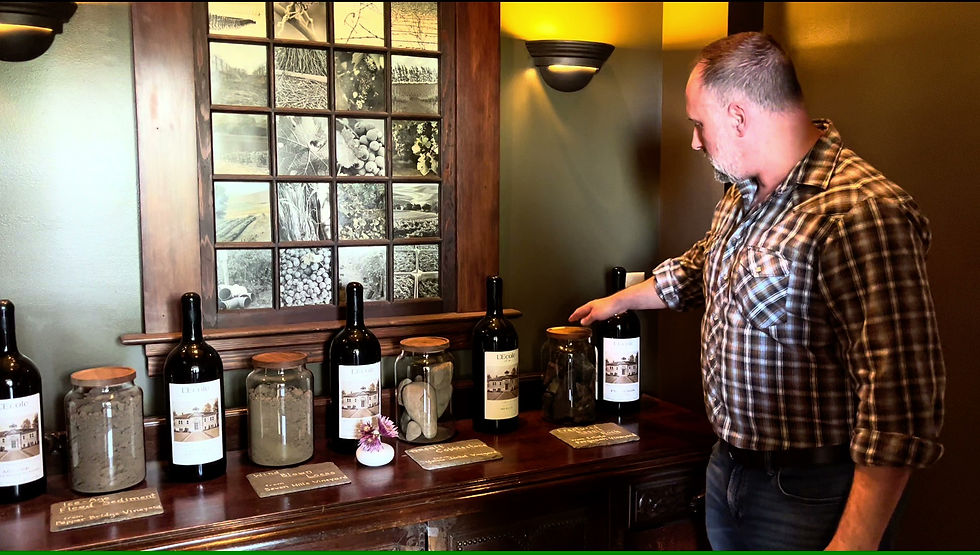
One important fact we learnt: Their wines with white label come exclusively from grapes grown Walla Walla vineyards while their black label wines are crafted with grapes from a variety of places.
And we proceeded with the wine tasting. We started with a Chenin Blanc and a Bordeaux-style Sauvignon Blanc Semillon blend..
Some of our brief white wine tasting notes follow.
L'Ecole no. 41 Chenin Blanc 2024: Very herbal - specifically sage, thyme and lavender. Very mineral, even salty. Medium to light body, precise acidity level, clean and refreshing. Clearly crafted only in stainless steel and no malolactic fermentation. It comes from vines planted in 1979 in Yakima Valley.
Luminesce, Semillon, Sauvignon Blanc: Aromas of lime, sage and lavender. Also predominantly herbal but more fruity, I thought. Crisp and acidic producing a very juicy and refreshing result. Crafted with a typical Bordeaux white wine blend.
And we continued with the red wines guided by an excellent discussion by Ben of their two main vineyards, Ferguson (named on their founder's honor) and Seven Hills.
Our red wine tasting notes:
2022 Estate Merlot, 85% Merlot with the balance mostly Cabertnet Sauvignon and a splash of Cabernet Franc. Crafted with vines from 900 ft to 1,100 ft elevation on loes soil.
2023 Malbec Walla Walla Valley, crafted from Seven Hills vineyard. Aged in 40% new French oak barrels for 18 months. Bold, bursting with fruit aromas while also showing bouquet. We thought it was closer to Mendoza than Cahors style. Bright. It was Jerry's favorite.

We were travelling light and could not fly wine with us. Therefore, we chose to purchase for consumption during the trip their Malbec which was very fruity and with its silky tannins seemed to us readier to drink. We tasted that bottle from the rooftop of a hotel in Portland, OR, while watching the 4th of July fireworks. Excellent pairing we thought!
The following flyer provided excellent information about L'Ecole's wines and terroir:


I was able to find the following wine in the Fine Wine and Good Spirits stores in Pennsylvania:

The rest of L'Ecole no. 41 wines can be purchased at https://www.lecole.com/
The second winery we visited was Valdemar Estates, just Southeast of Walla Walla in the border with Oregon. Jesús Martínez Bujanda hosted us. Jesús and his sister Ana are the fifth generation owners of the Rioja winery, founded in 1889 and mainly known for their Conde de Valdemar wines. Jesús fell in love with Walla Walla during his college times at University of Washington and decided to build a winery. He and his family moved to the US and started Valdemar Estates in 2019 - the first non-US winery in the state. The building has been highly praised in the wine industry. I was impressed by its elegant design, noble construction materials, and functionality.

Valdemar Estates has the first US fully inclusive and accessible tasting room. The indoor space is tastfully furnished while the outdoor space has the feeling of enjoying vacation in a remote place. Both offer wide views of the arid land surrounded by even drier mountains.
We entered the winery from the bottom floor escorted by stripes of shade in a long and minimalist courridor leading to a large and heavy metal door. We felt a mix of peace, mistery and anticipation.

Jesús welcomed us and told us about the winery history. The following video presents an educational discussion about types of oak for barrel aging of wines followed by interesting information about gthe use of oak in their Walla Walla and La Rioja wines.

We then visited the winemaking facility. All rooms played together in a succession of spaces organized around the phases of winemaking and the common purpose of producing excellent wine with state-of-the-art equipment while underscoring logic, minimalism and functionality.

An elevator and a long staircase led to the upper floor where we were offered a glass of sparkling ... We loved that welcoming glass since it presented a touch of class (I also welcome participants to my wine tastings and events with a sparkling wine glass). We admired its appearance, with constant strings of very small bubbles, enjoyed the elegant aroma, and loved taste and mouthfeel. It flew beautifully through our thirsty mounts and throats. It seemed light, mineral, refreshing, showcasing citrus and tea leaf aromas. When Jesús told us that it was non-alcoholic we loved it even more: the first wine of that kind that I have enjoyed! When he told us it was not crafted with grapes but a special formula including 6 types of tea we were amazed!
The tasting room had a desk with aromas excapsulated in laboratory vessels. They reminded me of my times as a chemist during my college and early career times. They were delicious and the arrangement was educational.

We then proceeded to the outdoor terrace tasting area. See below a short panoramic view.
Jesús had staged everything with his very personable tasting room manager Tommy Long.
We proceeded to tasting his wines accompanied by a wonderful Spanish charcuterie dish with several kinds of Iberian dry meats, aged cheeses and the tycical slightly hot and pickled green peppers called "gildas".

We started with the Chardonnay which was, as Jesús explained, more French style than American, with very restrained French oak influence, rated 94 points by Decanter. We then continued with an amazing Syrah 2024. We later learnt that Decanter had awarded their Syrah Las Canteras 2021 vintage (not part of this tasting) 96 points, and included it in the 2025 list of top 50 US wines.
I have added my tasting notes below, although we all know this can be very subjective.
Valdemar Estates Chardonnay 2024, French Creek: Shiny light gold color with primary aromas of tropical fruits such as pinneapple, sage and rosemary. Slight oak influence from the fermentation in oak barrels but I did not perceive any hint of prolonged aging in oak. In mouth it was saline and acidic, veering towards the Chablis style. 14% ABV. Refreshing, complex and elegant.
Valdemar Estates Syrah 2021, Walla Walla: Deep garnet color of medium coverage. Primary aromas of dry cherries and menthol with hints of paprika and smoke. In mouth it was self-restrained and subtle, with medium body and approachable tannins, almost silky. Very pleasant aftertaste with some level of depth and lenght. European style wine, much closer to Northern Côtes du Rhône than South Australia, with some Rioja characteristics probably from the way this Rioja-originated winery crafts its wines.
Valdemar Estate Cabernet Sauvignon 2022, Walla Walla: Darker garnet and more opaque color. Primary aromas of crashed pomagranate, ripe raspberry, sage and black pepper. Sam insisted he detected bell pepper. In mouth it was dense, medium to full bodied, with perfect acidity and powdery / chalky tannins. Deep and long.
Devyani Gupta, the winemaker, had worked in a prior phase of her career at Kiona winery. J. J. Williams, the owner, sent her kind regards. I will be posting a report on Kiona in Red Mountain and some wineries near Prosser soon.
Valdemar Gran Reserva 2015: This vintage had an early Summer with hot and dry conditions that produced concentrated and ripe wines. This wine was aged in 50% French and 50% American oak, 50% new, for 3 years, followed by several years in the bottle. Imagine: they were serving now, in 2026, a wine from 11 years ago. Not many wineries in the world age their wines for such a long time and this makes Rioja unique. This practice is out of the fashion imposed by present day international wine gurus. While it is true that such long-aged wines may lose some of their primary aromas such as fruits and flowers, the natural chemical reactions that are allowed to happen result in wines with complex tertiary aromas that old-fashion experts and I much appreciate. Deep nose of ash and red fruit marmalade. In mouth it had perfect acidity, medium body, and still alive drying tannins very finely grained. Jerry said something that puzzled me initially but ended up expanding my perception of this wine: "The oak is the plate and the wine is the food on top of it".

The picture below shows Sam and Jerry tasting the wine. The following wine menu includes more details about these wines such as the grape blend and vineyard/s of origin.
Jesús, thank you for your Spanish-style hospitality and flavors!
Since then, Sally and I have adopted Marabela as our drink to go when we want a refined sparkling "wine" experience without the alcohol. Congratulations, Jesús!

Valdemar Estates wines from Walla Walla can be purchased at https://valdemarestates.com/
The following Valdemar wines can befound in PA Fine Wine and Good Spirits shops:
Marabela sparkling tea
Conde de Valdemar Reserva , Rioja
Inspiracion , Rioja
Other than the wineries, Walla Walla was a beautiful town. If was mostly populated by French Canadian and Southers Italian migrants as a fertile agricultural land. See some pictures below depicting some buildings, restaurants, wine tastings rooms and countryside. One of the pictures shows a monument to the Italian migrants.
And that was all about our Walla Walla July 2026 visit. I hope you enjoyed readig about it. Your comments or questions will be welcome.


