Wines from South Africa

Updated: Jul 24
Dear friends,
All my life I have had a passion for maps. Let's start with the following simplified map of major South African wine districts. You may look at it periodically while reading this post to see where each of the wines comes from:

On June 28th, 2026 our AWS City of Pittsburgh chapter hosted international wine expert Jim Clarke for a South African wines tasting. Jim is the author of books such as The Wines of South Africa and received in 2020 the International Louis Roederer Wine Writer Award for Feature Writing. His present assignment is Wines of South African (WOSA) Country Manager for the US.

We held the event at the historic Morrow Barn in Penn Hills and had 47 participants with as many invitees as chapter members.


The wines tasted were the following:

Participants were welcomed with a glass of Graham Beck Cap Classique, a flawless sparkling wine crafted using the traditional method. Sally and I commented about its very fine and constant bubbles, and the lees-derived aromas of bread and almond. We liked it so much that we have purchased more bottles from a PA wine store for our domestic consumption.

Ricardo Llovet introduced Jim Clarke and he started the presentation while the first wine was served.
Groot Constantia Sauvignon Blanc 2024, Constantia

This mineral, clean. herbal and refreshing wine came from a predominantly Sauvignon Blanc region in the peninsula south of Cape Town. The winery can be visited in a short trip from the city. This Northern French varietal thrives in that region because of the cool ocean currents and wind.


The second wine was served.
De Wetshof Limestone Hill Chardonnay 2025, Robertson

This Chardonnay came from the Limestone Hill which encompases a very small and terroir-specific group of vineyards within the Robertson district which is part of the Breede River region.

It was crafted with no oak to preserve the full terroir expression. Alhough this area is farther away from the sea, there are prevailing winds traveling through the valley that keep it cool. The elevation does the rest. Accoring to Jim, the vines are planted in the oldest viticultural soil in the world. Salty-mineral and citrus-acidic with fresh lemon, green apple and lavender aromas, in a crisp and creamy structure providing weight in the palate.
And then we moved to the most famous South African wine region of Stellenbosch.
Ken Forrester Old Vine Chenin Blanc 2024, Stellenbosch


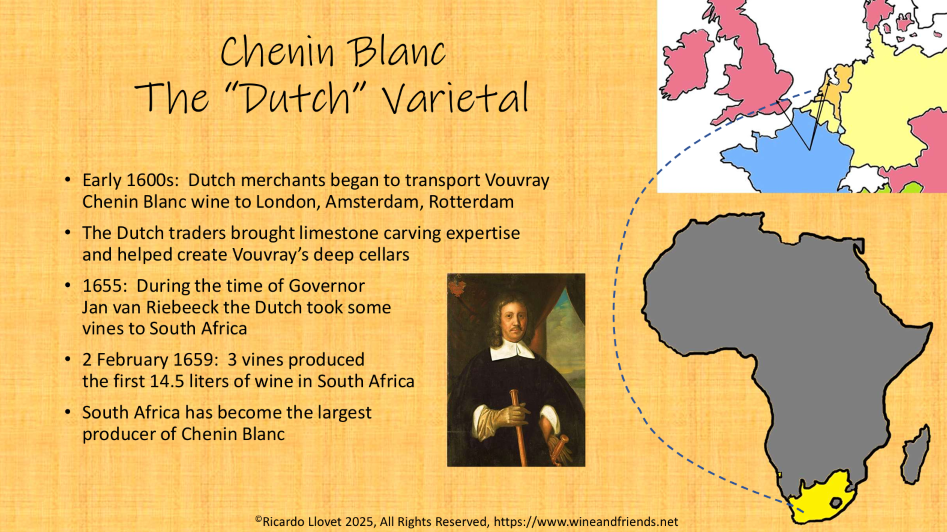
This Chenin Blanc was voted as our favorite white. It presented a balance between the prior two wines with its minerality and herbal aromas approaching the Sauvignon and the apple and tropical fruit aromas and creamy structure approaching the Chardonnay. There is more Chenin Blanc planted in South Africa than in France's original Vouvray appellation, and Ken Forrester produces so much that some call him "The King of Chenin Blanc". The vines were imported in the 1970s from Vouvray.
The South African Chenin Blanc history is summarized in the following slide from my OLLI at University of Pittsburgh course:
Stellenbosch is located to the East from Cape Town. Stellenbosch is the more traditional visit to a South African wine region. The landscape is spectacular with steep mountains sorrounding the valleys.


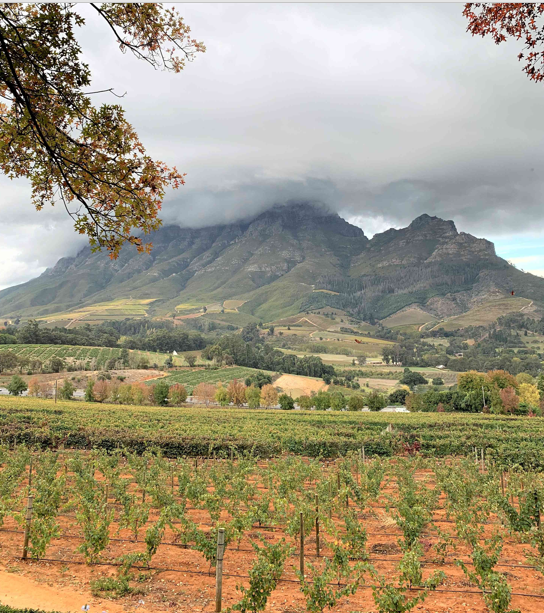
Stellenbosch has a variety of soils but clay is predominant. It provides structure to the wines. Although clay retains humidity very well, it is so dry during the grape ripening season that irrigation needs to be used. See the following chart:

And we started with the reds with a Pinotage, the emblematic red varietal of South Africa.
Beaumont Jackals River Pinotage 2022, Bot River

This wine was floral with petunia and geranium and showed vanilla from oak aging. Medium body with velvety tannins structure. This varietal ripens very fast and the harvest must be precisely timed to prevent acidity loss.

Pinotage is a cross of two vitis vinefera varietals actually created in this country as summarized in the next slide from my OLLI at University of Pittsburgh course:

Jackal's River is a single vineyard within the Bot River district, neighbor to Elgin and about 50 miles Southeast of Cape Town. This area benefits from the marine climate from Walker's Bay with the reputation of its wines ever growing.
I thought our next wine was very interesting and I almost voted for it as my favorite.
Kaastelberg Carbonic Syrah 2025, Swartland

Carbonic maceration is a fermentation technique with the grapes (or even the grape bunches) not pressed or crushed. The grapes at the bottom of the tank break down due to the weight of the grapes above them and produce Carbon Dioxide which displaces the Oxygen. The fermentation occurs inside entire grapes until their internal pressure breaks them. The resulting wines are very fruity and have relatively low tannin content. Young/jovial wines full of fruit and flower primary aromas with secondary lactic aromas I really enjoy. And this one was no exception. I detected nectarine and dry strawberry amongst other fruits as well as violets. Full body with velvety, slightly drying, tannins, and freshness feeling in the palate. The style was closer to Upper Rhône Valley than Southern Australia.

And our final wine was:
Nebukadnesar Babylonstoren Red Blend 2024, Simonsberg-Paarl

This was the group's favorite wine. Based on Cabernet Sauvignon blended with Cabernet Franc, Merlot, Malbec and Petit Verdot. Full body, powerful but elegant, with dense but velvety tannins, deep and long with a feeling of warmth while retaining plenty of primary aromas. Aromas of ripe black cherry, plum, blackberry, blueberry, pansies and Mediterranean garrigue. The cedar and chocolate creme éclair bouquet developed with the help of 24 months of aging on almost all new French oak.
Chris Draves (us_admin@babylonstoren.com), their US rep, presented the wine.

The winery's and wine's names refer to the famous Babylonian king, the conqueror of Jerusalem that built the Handing Gardens, one of the Seven Wonders of the World. The winery has beautiful gardens on his honor.


Our AWS chapter is very focused on food. Some would say it is as important in our events as the wine. In this case we had the challenge to make South African recipes that we, except Nonie and Marti, had never cooked before. Some of them had very colorful names such as Chakalaka, Bobitie, Main Tomato Bredie, SA Yellow Rice and Malva Pudding. Other dishes prepared by the event participants were Ghanaian Salad, Cucumber Salad, Roasted Veggies, Paste Salad, Trout Pate, Cheese & Crackers, Philo with Cheese, several kinds of appetizers and sweet crunchies.
See below some photos with our event participants:
Graham Beck sparkling wine can be found in some PA state stores. I purchased it in the Westmoreland Mall store. The rest are available through on-line suppliers unless they start showing up in PA stores.
See below Jim Clarke's and WOSA's Websites:
I hope you found this post interesting. If you have any questions let me know.


